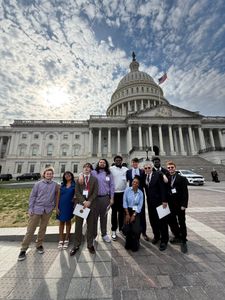
Held March 25-27, 2026, the event brought 90 students from 28 colleges and universities to the nation’s capital for a hands-on program focused on environmental policy, civic engagement, and direct advocacy with federal lawmakers.
Representing Catawba College were Iain Bass, Lance Morrison, Gavin D’Souza, Jalen Brooks, Nomsa Kamanga, Abby Kluttz, Justin Leonard, Jorge Rodriguez, KJ Uwandji, and Maribel Sanchez.
Their participation reflects Catawba’s commitment to preparing students not only for professional success, but also for lives of purpose, leadership, and service. Through opportunities such as Advocacy Day, students are able to connect classroom learning with real-world experience and engage meaningfully with issues that affect communities, ecosystems, and the future of the planet.
During the three-day program, students received training in environmental policy and civic engagement before meeting directly with members of Congress and their staffs on March 26. In total, participants met with more than three dozen congressional offices and urged lawmakers to oppose policies that contribute to forest destruction, harm frontline communities and wildlife, and intensify the climate crisis.
“Each year, our Advocacy Day brings together a new generation of leaders who refuse to accept environmental destruction as the status quo,” said Bob Musil, president and CEO of the Rachel Carson Council. “These 90 students aren’t just learning about policy, they’re shaping it, meeting directly with lawmakers to demand bold, science-based solutions that protect our communities, our climate, and our future. Their voices are a powerful reminder that young people are not only paying attention, they’re organizing, mobilizing, and holding Congress accountable.”
The experience also created valuable exposure to careers in public policy and advocacy. Students participated in discussions with policy professionals and senior legislative staff, gaining insight into how environmental issues are debated and addressed at the federal level.
“When young people come together to engage directly with policymakers, they truly transform widespread environmental concern into a singular effort,” said Joy Reeves, director of policy for the Rachel Carson Council. “That kind of youth-led advocacy is essential to building real momentum for environmental action.”
“Advocacy Day gives real, hands-on experience beyond the classroom,” said Diego Tovar, director of campus and civic engagement for the Rachel Carson Council. “At a time when federal support for higher education is under attack, programs like the RCC’s are more important than ever, ensuring students still have the opportunity to engage directly with decision-makers and turn their knowledge into action.”
For Catawba students, the event aligned closely with the College’s long-standing commitment to sustainability, civic engagement, and educating students to become thoughtful leaders and good citizens. It also reflected Catawba’s emphasis on connecting academic study with practical experience that prepares students to make a difference in their communities and beyond.
The Rachel Carson Council’s annual Advocacy Day is held each year during the last week of March as part of its ongoing mission to empower and mobilize future environmental leaders.
About The Rachel Carson Council
The Rachel Carson Council, founded in 1965, is the national environmental organization envisioned by Rachel Carson to carry on her work after her death. We promote Carson’s ecological ethic that combines scientific concern for the environment and human health with a sense of wonder and reverence for all forms of life in order to build a more sustainable, just, and peaceful future.
