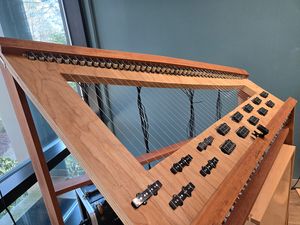
Yet digging into how it does that with Aaron Shay, assistant professor of music at Catawba, reveals the complexity, years of thought, and layers of programming behind it. He was hoping to create a musical and meditative space, especially with nature, and has accomplished just that. It is clearly a labor of love.
Aaron explains the programming behind the music. He selected thirteen music styles as guides for the compositions. Some are styles that Aaron originated. Others are loosely based on styles such as Indian music, selected composers, and fusions such as “what it might sound like if Beethoven wrote marimba works”. The program operates via a mini-PC. Notes sound as solenoid cells strike piano wires strung through a frame. The music comes through six speakers which Aaron built, creating a surround sound effect.
The programming, Aaron says, “took forever. I started probably thirteen years ago. And I gave up two or three times.” But he came back to it. “I started with a Bach patch. Bach, especially the keyboard works, feel like they could spiral on forever. I started trying to capture that feeling. It establishes a theme.” It was a learning process.
The instrument in the CENV lobby is the third sonic installation that Aaron has created. The first one to incorporate nature sounds, it is nicknamed “Chirps.” Aaron recorded sounds in Catawba’s Stanback Ecological Preserve over three summer nights. He set up a recorder and left it from 7:00 p.m. to 10:00 a.m. “I would spend hours listening and looking at the audio file of what it recorded, and see, ‘something interesting happened here’. What I learned is that in the preserve, 2:00 a.m. sounds nothing like 3:00 a.m., and 3:00 a.m. sounds nothing like 4:00 a.m. There’s a daily cycle to the sounds. And there’s the dawn and evening chorus of the birds.”
At first, he tried to have specific bird songs influence the music, manipulate the melody. “But to me, it cheapened nature. Our musical traditions are great and rich and there’s a lot going on. But we’re limited to twelve notes to the octave. Birds aren’t. They have no problem singing what we might call blue tones, or quarter tones. Because of that, I sort of left them to do their thing, and the music happens at the same time. They merge to become a soundscape, but there’s enough textural difference that they don’t step on each other.”
Aaron’s inspiration for these creations came from a dream. “You know how dreams are, they are kind of indescribable. Things that don’t exist. And there were these giant metal structures that were literally playing music. It stuck with me, and I thought ‘you could actually do that’.”
COMING SOON!
Stay tuned for video of the sonic installation in action.
He created something similar to what he saw in the dream, a giant seven-and-a-half-foot tall metal pipe with strings coming through holes, down to the base. “I built this thing and went to tune it. I’d used piano wire.” He needed it for its 7-foot length. “But I didn’t understand piano tension. The guitar tuner I’m using to tune it wouldn’t turn anymore, and it’s still two octaves too low, not even close to what I needed it to be. That’s when I found out that piano tension is 58,000 pounds. Whereas I’m used to guitar tension, which is about 110 pounds.” He describes his first attempt as “an epic failure.”
He didn’t let that stop him. He kept the idea and, like jazz, improvised on it. “I defaulted to things I understood. And I understood guitars.” Having studied guitar-making with two great luthiers, his next try featured four round guitar bodies. It was his first successful sonic installation. The second, suspended from the ceiling, was a type of marimba. Each was displayed in galleries.
Aaron’s fascination is the programming. “To my musical mind, that’s still the most interesting part. Not really the mechanical device. Historically, when composers are composing, they have to make all these decisions. This note, this rhythm, this chord, and once those are established, they’re set in stone. The composition is done. With the software, you can give it options, you say this note, that chord, this chord, and then a random number generator picks it every time. So, it’s different every time. But it’s still within boundaries of the set musical styles. The key and tempo are different every time. It will never repeat itself. The math of it repeating itself would be like winning the lottery a thousand times in a row. There are so many levels of random number generators picking. You might get something in a similar style, but the machine is improvising in that style.”
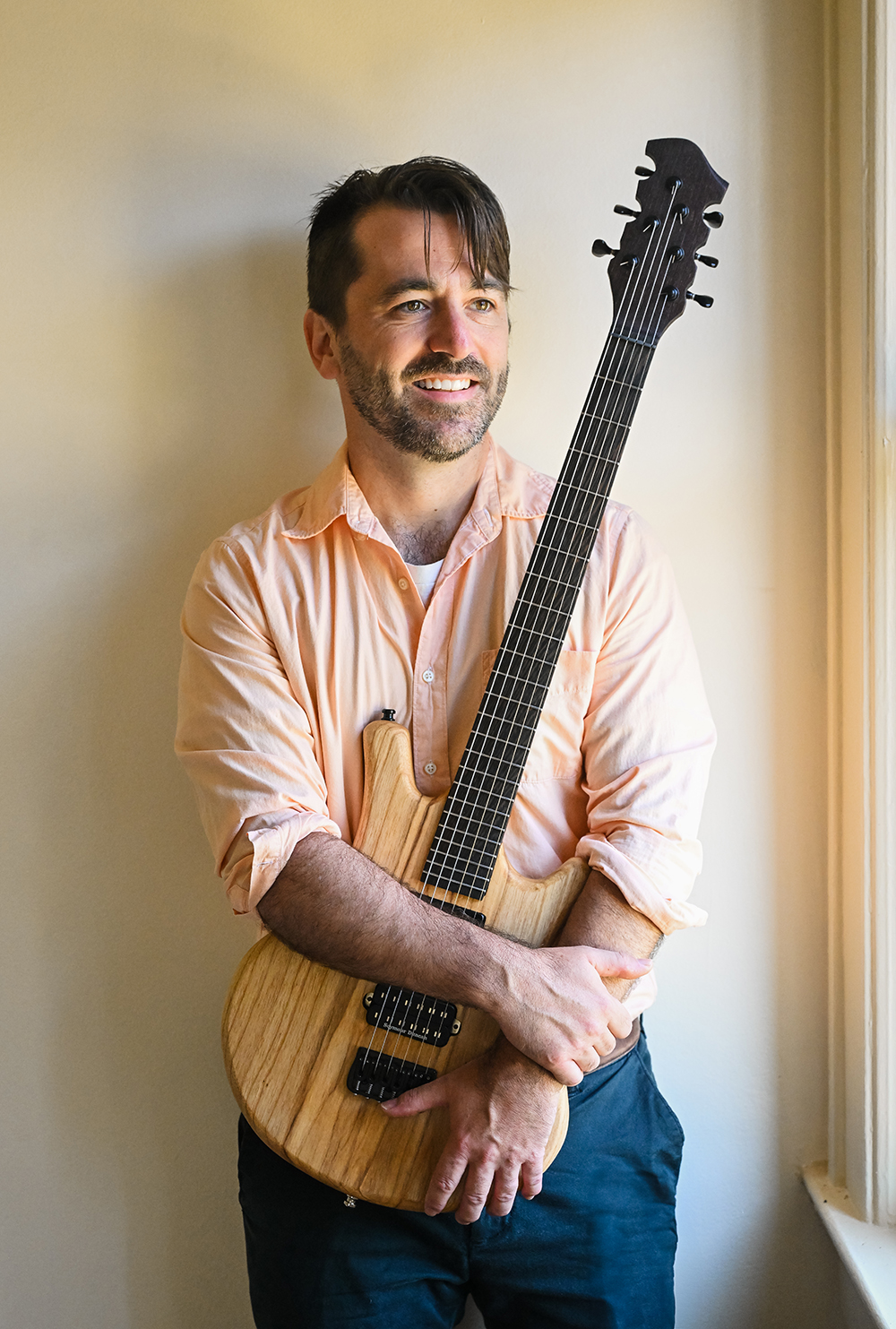
Aaron grew up loving music. His dad played music by ear. His mom kept the radio on the “oldies” station. “When I was nine, I really wanted to play guitar. I got the Sears guitar, it was black, which I was sad about, because I wanted the red one. I got really into it. What I realized was, if I’m giving an honest assessment, talent-wise I had good hands, but I didn’t have a good musical ear. Someone like my dad knew what he was hearing all the time and could play it. And it was frustrating. So, if I’m a good music teacher, and I hope I am, it’s because I really had to work for that side of it. I know what it’s like to struggle through certain aspects of learning music.”
Aaron holds a master’s degree in jazz and classical guitar performance. While some people are intimidated by and avoid something they don’t understand, Aaron went straight to it. “I was mostly interested in jazz because I didn’t understand it. I felt like I had learned a lot about music but there was this blind spot in my knowledge. I didn’t like not understanding what was happening.” Ultimately, he came to love the unique expressiveness of jazz.
He never planned on teaching. “I had a B.A. in music, and I was working as a recording engineer in Akron, Ohio, playing gigs, that sort of thing. Around 2010, colleges started to add music technology programs, classes like recording audio engineering. The problem was that a lot of the people who had graduate degrees in music didn’t work in recording studios. I just happened to work in a recording studio, and I also had a master’s degree in jazz guitar. I got called for two jobs within the same month. One was Kent State; the other was Stark State College in Akron. There was no real interview, I was hired. I found that I really enjoyed teaching, and I put a lot of time and energy into hopefully becoming a good teacher.” He discovered that teaching “is my favorite way to engage with music, with students. There’s something to be said about sitting alone in a practice room, and performing is great, but there’s something about the activity of bringing people along with you. When the students are passionate about what you’re passionate about it creates just a good day,” he smiles. Teaching led him to Catawba. “I saw the Catawba job posted. And I love the way Catawba approaches teaching popular music.”
Aaron names more things he appreciates about Catawba. “I like its liberal arts model of education. I like the idea that students, when they graduate, are well-rounded people. I think to be a good musician, especially a good songwriter, you have to be a well-rounded person, you have to have these life experiences that you bring into your music and your art. So, I love that. I love the green aspects, being in the Center for the Environment. And the cross-collaboration. Catawba is the right size and has the right culture for interdisciplinary works.” His sonic pool installation, he points out, is just one example of that creative cross-collaborative spirit.
